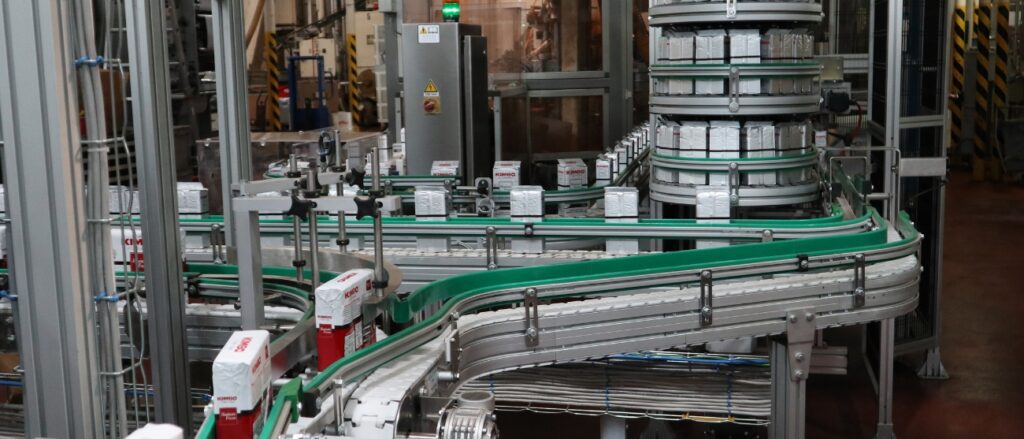
When designing a packaging line, attention immediately goes to the machines: which packaging machine to choose, what type of labelling machine to install, where to place inspection systems.
However, there is one element that determines the efficiency of the entire system even before thinking about the machines: the layout.
A well-designed layout is almost invisible. Operations flow smoothly, maintenance is quick, and operators move without obstacles.
On the contrary, a poorly designed layout makes itself felt every day, with downtime, bottlenecks, cleaning difficulties, and waste of space and time.
Many issues that seem to originate from the machines actually arise during the layout design phase.
A recurring machine stoppage at the same time every day, for example, may not be due to a technical fault, but to a buffer positioned in the wrong point of the line.
A cleaning process that takes twice as long as expected may be the result of conveyors placed too close to each other, not a surface sanitization issue.
Operators losing valuable minutes moving materials from one area of the line to another may indicate a flow design error, not a lack of staff.
The layout determines how machines interact, how materials move, and how operators work. And when the layout is wrong, even the best machines struggle to perform at their full potential.
Let’s look at the most common mistakes that compromise the performance of a food processing line.
1. Underestimating space for maintenance and sanitation
This is one of the most frequent mistakes: machines and conveyors positioned too close to each other, without considering that they will need to be accessed for cleaning, inspection, and component replacement.
In the food industry, this becomes a critical issue, as sanitation is not an occasional activity but an integral part of daily operations.
If a conveyor belt is trapped between two machines with insufficient lateral space, cleaning becomes superficial. Operators struggle to reach critical areas, downtime increases, and hygiene risks grow.
Even the most advanced Hygienic Design loses effectiveness if the layout does not support it. An open frame designed for drainage is of little use if there is no physical space to access the surfaces to be cleaned. For this reason, it is essential to consider not only the machine itself, but also the operational space around it: the room needed to open frames, remove components, allow operators to access with cleaning equipment, and move freely during sanitation procedures.
2. Ignoring material and operator flows
An efficient layout defines clear paths. Raw materials, semi-finished products, finished goods, and waste must each follow a precise flow, ideally unidirectional, from “dirty” to “clean”. When these flows intersect, the risk of cross-contamination increases exponentially.
The same applies to operator movement. If reaching a quality control station requires crossing the entire line and passing near the waste discharge area, there is a design flaw.
Every unnecessary movement is lost time and a potential food safety risk.
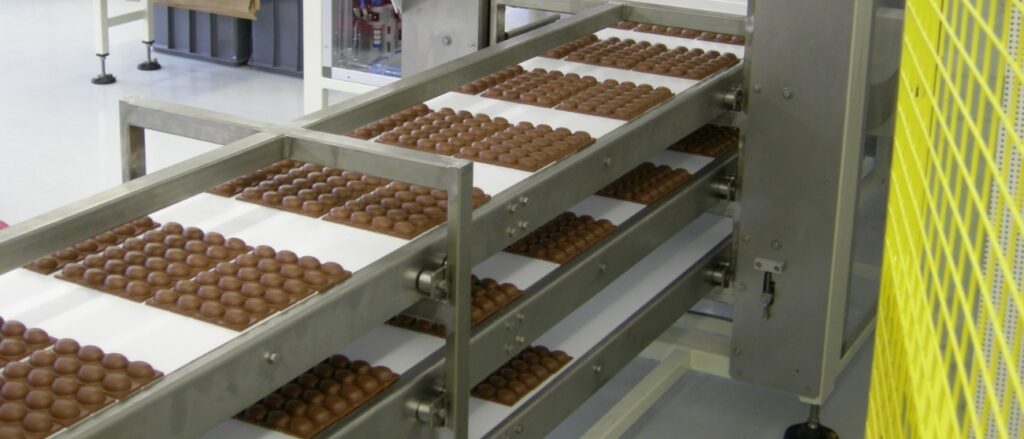
Physical separation between areas with different hygiene levels should be planned from the outset. The positioning of buffers and accumulation systems also makes a difference: a BAT Buffer placed in the right position can absorb downstream micro-stoppages without blocking the entire line. Placed incorrectly, it becomes just an obstacle.
3. Failing to plan for flexibility in format changes and future expansion
Food processing lines are not static. Formats change, production evolves, and volumes grow. Yet many layouts are designed without considering future developments. As a result, when it’s time to introduce a new format or add an inspection station, physical constraints become a barrier. There may be no space to integrate new elements, even if the modularity of conveyors would allow it.
Modularity is not just a feature of machines—it is a design principle that should also guide layout planning.
Systems like BAT are built on this logic: standard components that adapt to different configurations.
However, the layout must also include “growth areas” identified from the beginning—spaces where buffers, additional stations, or line diversions can be added.
Planning for flexibility may involve a slightly higher initial cost, but it leads to significant savings in the medium term, when production changes can be implemented in hours instead of weeks of downtime.
4. Choosing the wrong accumulation system (or not including one at all)
Every line includes machines operating at different speeds. Without an accumulation system, even a micro-stoppage of a few seconds can halt the entire production flow.
Yet many layouts either do not include buffers or size them incorrectly.
An oversized buffer takes up valuable space without delivering real benefits.
An undersized buffer cannot absorb flow variations and becomes ineffective.
Then there is the choice of system type: accumulation systems with product-to-product contact can damage fragile items such as biscuits or packaged snacks, even when using low-pressure solutions.
The BAT Buffer was developed precisely to address these issues: compact, zero-pressure accumulation that ensures operational continuity even during micro-stoppages.
However, the key point is this: buffers must be planned during the layout design phase and positioned strategically—not added later as a patch once problems arise.
5. Overlooking heights and elevation changes
It may seem like a minor detail, but operating heights make the difference between an efficient line and one that strains operators. Conveyors placed too high or too low force unnatural postures, increase the risk of errors and injuries, and slow down operations.
Height differences between conveyors must also be carefully calculated.
A sudden drop can destabilize fragile or unstable products.
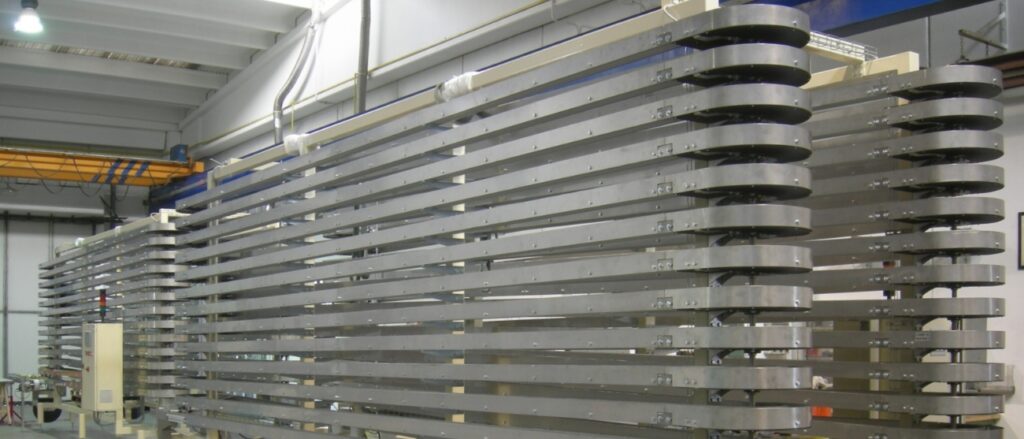
In some cases, when horizontal space is limited, spiral conveyors provide an effective solution, allowing elevation changes without occupying valuable floor space.
Ergonomics becomes an investment that translates into fewer errors, fewer stoppages, and higher productivity.
And it must be considered from the layout design phase—not added later with stairs, platforms, and walkways that complicate the system and increase costs.
The layout is designed once, but its impact is experienced every day
An effective layout is not the result of compromises between existing constraints—it is a strategic choice that impacts the efficiency, safety, and scalability of a packaging line for years.
Design mistakes come at a cost every single day: downtime, waste, operational difficulties, and complex maintenance. And in many cases, these are avoidable errors—preventable with a broader perspective and collaboration with experts who understand the production dynamics of the food industry. At M.H. Material Handling we support our clients from the earliest layout design stages, combining conveyor system supply with consultancy that starts from flow analysis and extends to space optimization. If you are designing a new line or looking to improve an existing one, get in touch with us: we can assess the most effective solutions for your plant together.


Co-Owner M.H. Material Handling Spa – For almost twenty years he has been working in the field of product handling during packaging, supporting companies that want to optimize the entire line. Always up-to-date on industry innovations and new materials, he makes his experience available to clients with the ultimate goal of eliminating interruptions and inefficiencies in the packaging process. Voracious reader, overnight writer and content creator.