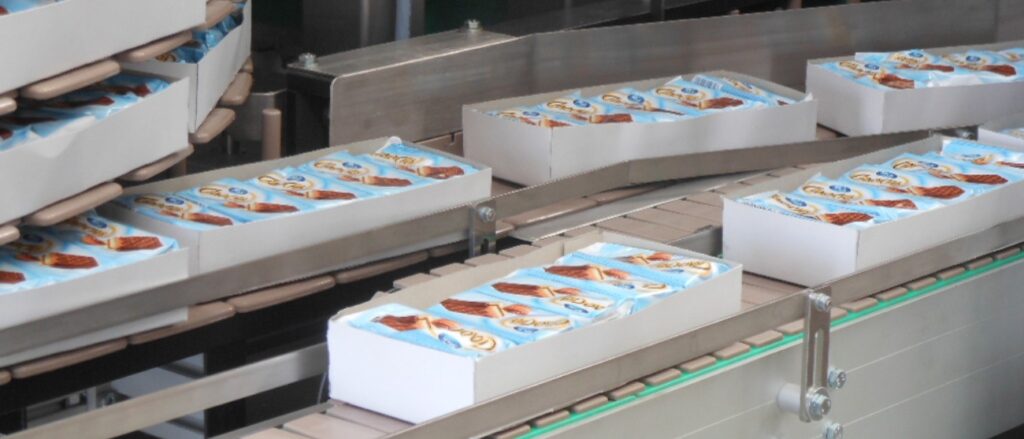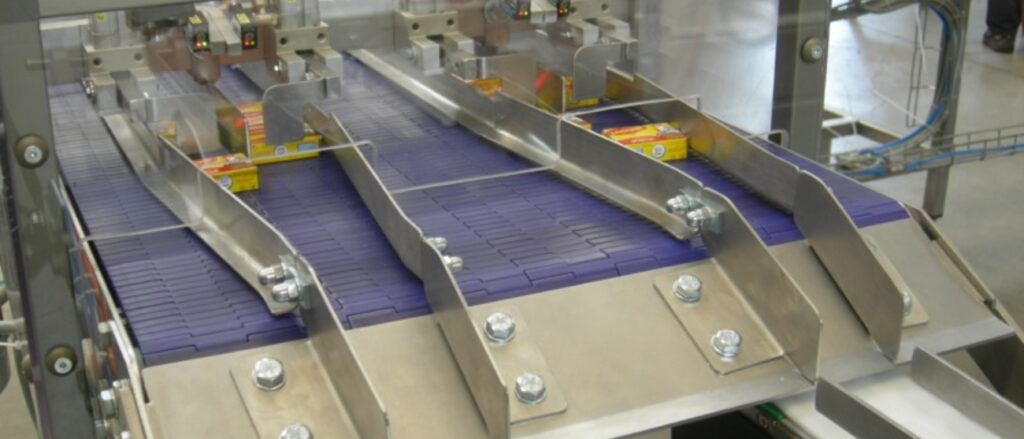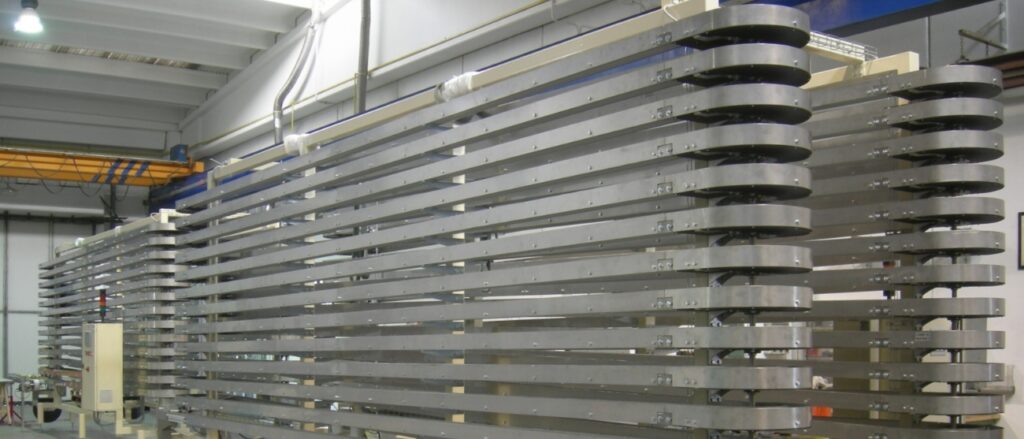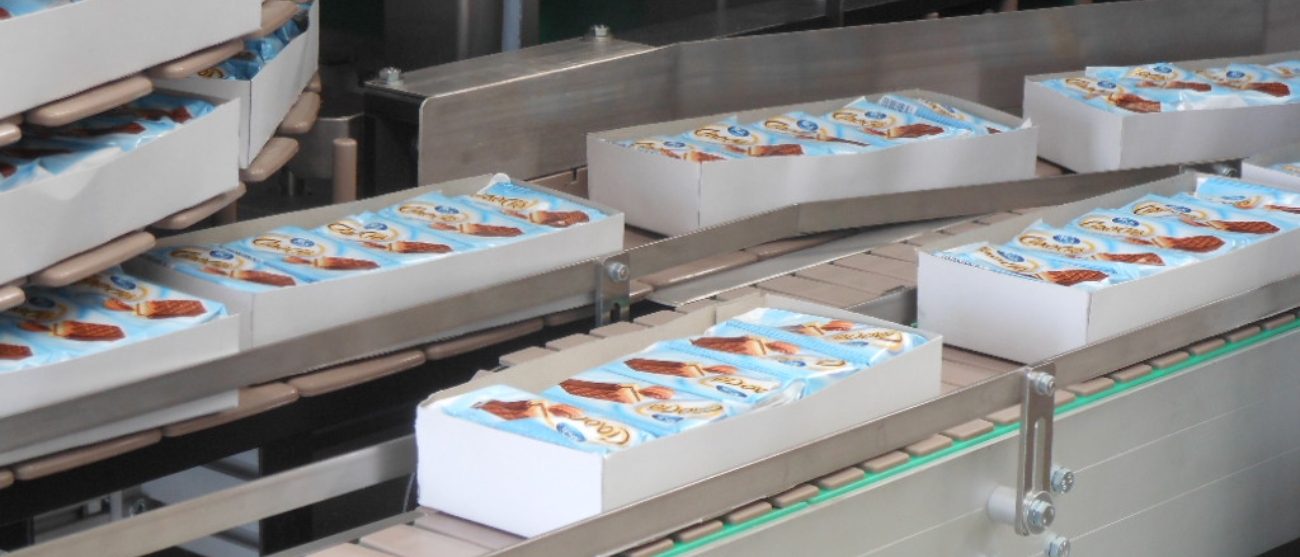
A divider distributes a product flow across multiple outlets along a packaging line. One of the most common situations arises when an upstream machine has a higher capacity than the downstream machines and the flow needs to be split into multiple lanes. This is typical of high-speed and flowpack lines, at the transition from primary to secondary packaging. We have been working in this field for over forty years, across the food, beverage, pharmaceutical and packaging sectors.
On these lines, the main parameters are line speed and cadence. Beyond a certain output rate, even the fastest secondary packaging machines cannot keep up. This is the same limitation encountered with mergers.
Splitting the flow into multiple lanes also helps ensure machine reliability and durability over time. Downstream, this may mean using several product arranging units or a single pick-and-place machine operating on multiple lanes simultaneously.
Diverter or sorter? Understanding the differences
The term divider, however, covers different types of equipment. The most immediate distinction is between a diverter and a sorter.
A diverter sends identical products into different lanes without changing how the products themselves are handled.
A sorter, by contrast, can also separate products according to specific criteria. Different boxes are directed to different outlets and are not treated identically, because a particular code or product is routed to its designated outlet. From a design standpoint, a sorter consists of a straight conveyor section with lateral outlets.
The 7 parameters that influence the choice
Deciding whether you need a diverter or a sorter is only the starting point. Before comparing technologies, it is worth establishing the following:
- the nature of the product: its shape, stability, fragility and deformability,
- line speed,
- cadence,
- the number of outlets required,
- whether the product can be touched,
- whether it can withstand pressure,
- product dimensions.
The most common solutions and when to use them
The deciding factor is the number of outlets. The selection criteria change significantly between a one-to-two divider and a multi-lane system.
Multi-lane systems require at least a channel-system divider, suitable for products that can come into contact with one another. Because contact is permitted, the divider does not space the products at set intervals: instead, it stops them in the channel, allows them to accumulate, and then switches channels. A multi-channel solution can still be considered for fragile products, but only when it is absolutely certain that the preceding product has cleared the channel.
In multi-lane flowpack systems, we use a sequence of one-to-two dividers. The application becomes more complex when products are fragile or low-profile, with a risk of overlapping.
A flap divider moves the product by making contact with it, provided the product can tolerate this. It is limited to two outlets: to obtain more, several finger-type dividers are generally arranged in a cascade. This is the simplest and therefore least expensive solution. Essentially, it consists of a deflecting paddle, with the limitations described above.
The soft touch system guides the product gently and is used on flowpack lines where accumulation is not possible. This solution also normally operates with one inlet and two outlets.
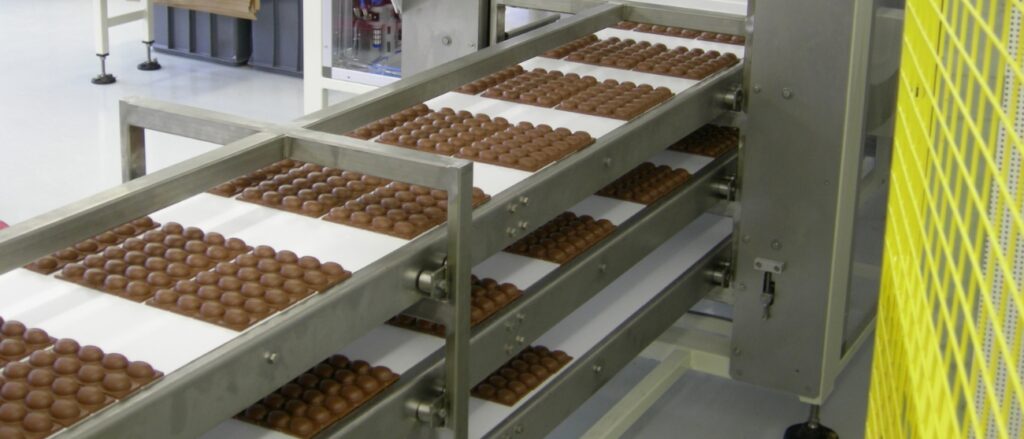
For robust, stable products such as cartons, boxes or trays, a mechanical multi-lane divider is a good solution, directing the flow by means of pallets, mobile channels or drawers.
Special solutions and when they make sense
Magic Sorter
When a product is very flat, thin or deformable, side guides can become a problem. The product may slip between the guide and the conveyor surface and become jammed.
In these cases, M.H. uses the Magic Sorter as either a divider or a merger. Product movement is controlled by a modular chain with embedded balls, suitable for items that cannot be handled using conventional side guides.
The Magic Sorter also makes it possible to create multiple outlets with the same system. This flexibility does, however, come with a throughput limitation: in the fastest applications, it can handle approximately 120 pieces per minute, which is lower than the throughput achievable with other sorting technologies.
AIM
AIM combines a modular conveyor belt with a pneumatically actuated, recessed pusher. The system acts on the lower part of the product, moving it through contact with its side. It is therefore suitable for non-deformable items that can withstand lateral contact.
Its main advantage is washdown suitability. The pneumatic actuation system withstands frequent washing, particularly when a dedicated stainless-steel cylinder is used. AIM can achieve an indicative maximum throughput of 120 pieces per minute.
Like the Magic Sorter, AIM is not used on flowpack lines: the small size of the products prevents the balls or the pusher from controlling them properly. In this case, the limitation is related to product dimensions, not line throughput.
ARB
ARB is a solution intended exclusively for end-of-line applications, where larger products such as boxes and other packages ready for subsequent processing stages are handled. One of its most common applications is feeding palletisers.
Product size alone is not enough to determine whether it can be used. The contact surface must also be checked: the bottom of the product must be even. This technology therefore requires specific conditions and differs from the dividers used between primary and secondary packaging.
Cost is another factor in the decision. ARB requires a higher investment and would not be justified where a simpler solution can perform the same task. It is therefore considered when the product type and end-of-line application genuinely warrant its use.
How to choose the right divider
Once these points have been clarified, the most suitable technology becomes much easier to identify.
Without this analysis, there is a risk of choosing a divider based on throughput alone, overlooking product characteristics, pressure resistance and the operating environment.
At M.H. Material Handling, we design and integrate all these solutions, from mechanical multi-lane dividers and the Magic Sorter to Intralox ARB and AIM applications. We support our customers in analysing product flows and selecting the most suitable configuration.
If divider selection is still an unresolved aspect of your project, we can assess it together, considering the product, throughput and required destinations to identify the best solution.


Co-Owner M.H. Material Handling Spa – For almost twenty years he has been working in the field of product handling during packaging, supporting companies that want to optimize the entire line. Always up-to-date on industry innovations and new materials, he makes his experience available to clients with the ultimate goal of eliminating interruptions and inefficiencies in the packaging process. Voracious reader, overnight writer and content creator.