M.H. – Material Handling

Solutions to specific problems

Throughout my career, I have often come across companies who make the mistake of underestimating the importance of the packaging line of their products dei loro prodotti.

The result: Reduced efficiency and the risk that machines may not work at maximum capacity, or worse still, grind to a halt.

These situations happen because someone erroneously thinks that product packaging requires buying the primary and, if necessary, secondary packaging machines and nothing more, failing to take into account the systems necessary to connect them.

There is an image that often comes to mind when I have to tackle this kind of problem: I think of the conveyor belts like the circulatory system that carries blood around the body and allows the different organs to function. Different packaging machines have to be connected to each other by an efficient “circulatory system” that is able to iron out any discrepancies that may exist between them.

Underestimating the importance of this “circulatory system” can result in production problems and delays.

When would we need a storage system?

There are two situations in which storage systems are critical:

  • when we need to compensate for operating differences between two machines that are connected in series;
  • when we need to regain productivity during micro-stops of downstream machines.

The first condition typically occurs when an intermittent machine is connected to a continuous one; for example, when an upstream machine produces product groups at regular intervals, while the downstream machine requires an ongoing flow of products equidistant from each other.

In the second case, on the other hand, we have start-ups and shut-downs of two machines that are incompatible with each other.

In these cases a buffer is a simple solution that requires a few metres of conveyor belt to regulate the flow and avoid regular stoppages in the production process.

As you can imagine, the efficiency gains are significant.

Which buffer to choose?

The choice of system depends on various considerations (including financial ones) but there are three variables that must be kept in mind:

  • the operating method of the storage system;
  • the available storage space;
  • the recovery capacity.

It is only by carefully considering these factors that we can move to a rapid consideration of the investment in the purchase of a buffer.

How the buffer works

The buffer can either be LIFO(Last In First Out), in which, as the name suggests, the first product to enter the buffer is the last one to leave it, or FIFO (First In First Out), in which the first product into the buffer is the first one out.

Among FIFO systems, there is a choice of:

  • machines that are external to the production line;
  • machinery that keeps the product within the production line, gradually increasing the available transportation space. In the latter case, the product is fully traceable, and it is considered more of an advanced storage system rather than a buffer.

LIFO buffers are the cheaper and simpler models. They are particularly suited to non-perishable, with long expiry dates, that can wait a long time for final packaging.

FIFO systems, on the other hand, are recommended for fresh products that must pass through the packaging line within a limited time frame in order to retain their freshness. These machines are usually more complex and their price is often not far off that of the packaging machines themselves.

Storage space

The decision regarding the dimensions of the storage space is linked to the efficiency of the upstream and downstream packaging machines and the time it takes to bring them back online in cases of micro-stops. In cases of a longer stop caused by mechanical failure, it is unlikely that a system within the packaging line will be sufficient to avoid any interruption at all.

In most cases, the storage space can correspond to a production time of 2-5 minutes; obviously there may be situations in which the demand for storage is notably higher and in this case it is worth considering the cost-benefit analysis and the impact that the buffer’s presence might have on the time it takes to bring the packaging line back online.

Often, the long time to recover from a micro-stop is because the operator is unable to focus exclusively on fixing the problem, because the upstream products continue to arrive, with the potential for pressure and chaos along the line.
Real-world conditions have shown that the presence of a buffer can help to contain machine downtimes.

Another example might be whereproducts travel a long distance along the packaging line and the client wants the ability to fully empty them. In this case, the necessary space can rise to 20 minutes or more. Such situations are rare but can happen.

Recovery capacity

A properly sized packaging line requires a buffer that is able to recover the product during regular production. The downstream machine must also be able to work at a rate greater than its nominal one, usually 10%-20% faster.

The time for emptying the buffer depends on this recovery capacity.

For more information on this subject, I have published a video dedicated to choosing the right storage system.

M.H. is an Italian brand with thirty years of experience with handling movement and logistics within production facilities in every sector of industry. We offer dedicated solutions for LIFO and FIFO storage systems, tailored to the client’s needs.

Our wealth of experience and our innovative and technologically advanced solutions mean that M.H. is also able to support companies in optimizing and streamlining their packaging lines.
Insights, ideas and news
about product handling

Does increasing a production line’s throughput always mean producing more units?

Not necessarily. A high production rate depends on more than just how fast the conveyor belts move.

This is the starting point of the latest episode of ConveyorU, M.H.’s Academy dedicated to conveyor systems.

In this episode, Luca explains the difference between conveyor speed and production throughput, showing why achieving the right balance between these two factors is essential when designing a conveyor system.

The relationship varies depending on the product and the process: small items can be conveyed in large quantities even at relatively low speeds, while bulkier products may require faster conveying speeds.

A divider distributes a product flow across multiple outlets along a packaging line. One of the most common situations arises when an upstream machine has a higher capacity than the downstream machines and the flow needs to be split into multiple lanes. This is typical of high-speed and flowpack lines, at the transition from primary to secondary packaging. We have been working in this field for over forty years, across the food, beverage, pharmaceutical and packaging sectors.

On these lines, the main parameters are line speed and cadence. Beyond a certain output rate, even the fastest secondary packaging machines cannot keep up. This is the same limitation encountered with mergers.

Splitting the flow into multiple lanes also helps ensure machine reliability and durability over time. Downstream, this may mean using several product arranging units or a single pick-and-place machine operating on multiple lanes simultaneously.

Diverter or sorter? Understanding the differences

The term divider, however, covers different types of equipment. The most immediate distinction is between a diverter and a sorter.

A diverter sends identical products into different lanes without changing how the products themselves are handled.

A sorter, by contrast, can also separate products according to specific criteria. Different boxes are directed to different outlets and are not treated identically, because a particular code or product is routed to its designated outlet. From a design standpoint, a sorter consists of a straight conveyor section with lateral outlets.

The 7 parameters that influence the choice

Deciding whether you need a diverter or a sorter is only the starting point. Before comparing technologies, it is worth establishing the following:

  1. the nature of the product: its shape, stability, fragility and deformability,
  2. line speed,
  3. cadence,
  4. the number of outlets required,
  5. whether the product can be touched,
  6. whether it can withstand pressure,
  7. product dimensions.

The most common solutions and when to use them

The deciding factor is the number of outlets. The selection criteria change significantly between a one-to-two divider and a multi-lane system.

Multi-lane systems require at least a channel-system divider, suitable for products that can come into contact with one another. Because contact is permitted, the divider does not space the products at set intervals: instead, it stops them in the channel, allows them to accumulate, and then switches channels. A multi-channel solution can still be considered for fragile products, but only when it is absolutely certain that the preceding product has cleared the channel.

In multi-lane flowpack systems, we use a sequence of one-to-two dividers. The application becomes more complex when products are fragile or low-profile, with a risk of overlapping.

A flap divider moves the product by making contact with it, provided the product can tolerate this. It is limited to two outlets: to obtain more, several finger-type dividers are generally arranged in a cascade. This is the simplest and therefore least expensive solution. Essentially, it consists of a deflecting paddle, with the limitations described above.

The soft touch system guides the product gently and is used on flowpack lines where accumulation is not possible. This solution also normally operates with one inlet and two outlets.

For robust, stable products such as cartons, boxes or trays, a mechanical multi-lane divider is a good solution, directing the flow by means of pallets, mobile channels or drawers.

Special solutions and when they make sense

Magic Sorter

When a product is very flat, thin or deformable, side guides can become a problem. The product may slip between the guide and the conveyor surface and become jammed.

In these cases, M.H. uses the Magic Sorter as either a divider or a merger. Product movement is controlled by a modular chain with embedded balls, suitable for items that cannot be handled using conventional side guides.

The Magic Sorter also makes it possible to create multiple outlets with the same system. This flexibility does, however, come with a throughput limitation: in the fastest applications, it can handle approximately 120 pieces per minute, which is lower than the throughput achievable with other sorting technologies.

AIM

AIM combines a modular conveyor belt with a pneumatically actuated, recessed pusher. The system acts on the lower part of the product, moving it through contact with its side. It is therefore suitable for non-deformable items that can withstand lateral contact.

Its main advantage is washdown suitability. The pneumatic actuation system withstands frequent washing, particularly when a dedicated stainless-steel cylinder is used. AIM can achieve an indicative maximum throughput of 120 pieces per minute.

Like the Magic Sorter, AIM is not used on flowpack lines: the small size of the products prevents the balls or the pusher from controlling them properly. In this case, the limitation is related to product dimensions, not line throughput.

ARB

ARB is a solution intended exclusively for end-of-line applications, where larger products such as boxes and other packages ready for subsequent processing stages are handled. One of its most common applications is feeding palletisers.

Product size alone is not enough to determine whether it can be used. The contact surface must also be checked: the bottom of the product must be even. This technology therefore requires specific conditions and differs from the dividers used between primary and secondary packaging.

Cost is another factor in the decision. ARB requires a higher investment and would not be justified where a simpler solution can perform the same task. It is therefore considered when the product type and end-of-line application genuinely warrant its use.

How to choose the right divider

Once these points have been clarified, the most suitable technology becomes much easier to identify.

Without this analysis, there is a risk of choosing a divider based on throughput alone, overlooking product characteristics, pressure resistance and the operating environment.

At M.H. Material Handling, we design and integrate all these solutions, from mechanical multi-lane dividers and the Magic Sorter to Intralox ARB and AIM applications. We support our customers in analysing product flows and selecting the most suitable configuration.

If divider selection is still an unresolved aspect of your project, we can assess it together, considering the product, throughput and required destinations to identify the best solution.

How many types of conveyors are there, and how do you choose the most suitable one for a specific application?

In this episode of ConveyorU Academy, our mascot Convy asks Luca Fontana, CEO of M.H. Material Handling, who walks us through the main conveyor technologies available and the key factors to consider when making the right choice.

The most suitable conveyor depends on the type of product, the stage of the production process, and the characteristics of the line.

That’s why there is no single best technology for every application: it’s essential to find the right balance between different requirements, such as safety, speed, and the characteristics of the product being handled.

Want to improve your production line’s efficiency? Contact us and request a no-obligation MH Scan Solution consultation. We’ll help you analyze your application, identify potential issues, and develop a solution tailored to the actual needs of your facility.

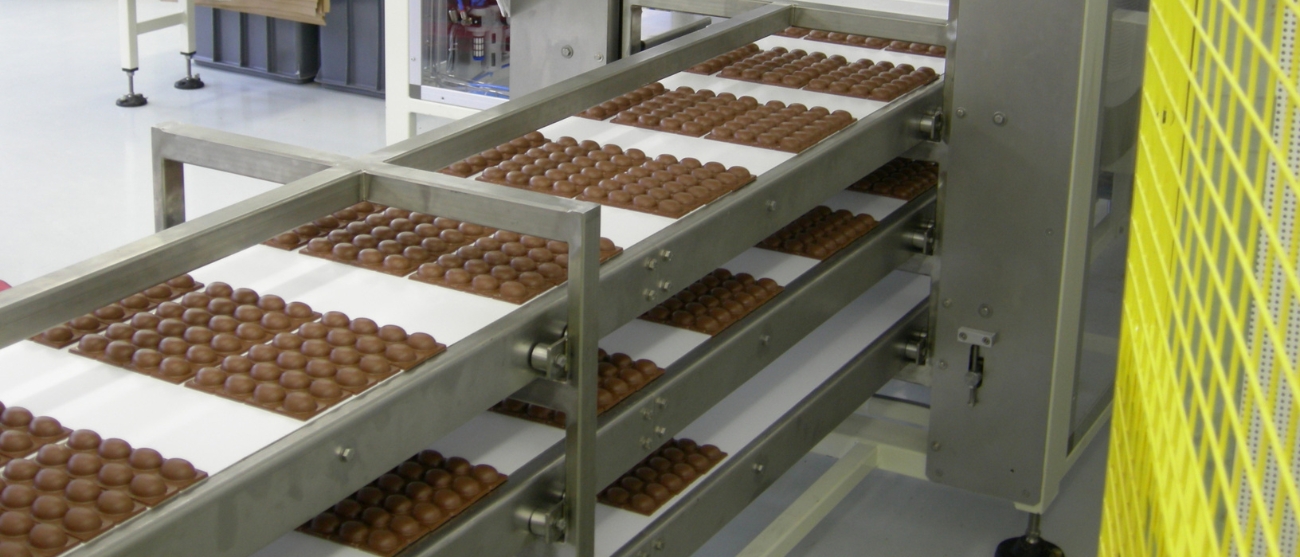
Chocolate is irresistible. Less so when it ends up sticking to the conveyor belts on your production line.

In the chocolate and confectionery industry, sugar-based residues can make conveyor cleaning particularly challenging, especially when products move through multiple processing stages before reaching the packaging area.

At M.H., in collaboration with Steam Italy, we have developed a cleaning system designed for different conveyor configurations, from continuous-surface monolithic belts to modular plastic chains.

Different conveyor types come with different characteristics and cleaning requirements, which means they also require different cleaning approaches.

Do you have a specific cleaning challenge on your production line? Contact us: we can assess your conveyor configuration together and identify the most suitable solution.

A high-quality packaging line can deliver reliable performance for decades, especially when supported by careful engineering and proper maintenance.

The service life of a system represents significant value, but being fully operational does not always mean it can meet today’s production, technological and regulatory requirements.

New packaging materials, sustainability goals, and increasingly demanding industry standards require systems capable of evolving – a particularly important consideration in the food industry, where hygiene, ease of cleaning, and safety are fundamental requirements.

Do you want to learn how to adapt your system to new regulations and changing production requirments?

Contact us for a technical consultation.

Converging multiple product lanes into a smaller number of lanes may seem like a simple operation. In reality, the way products are collected, timed and delivered to the downstream machine can have a significant impact on the consistency of the entire process.

This is why designing a lane merger is not simply a matter of considering line speed. First of all, it is necessary to understand how the product behaves: its shape, stability, fragility, ability to run in contact with other products, and the pitch required by the downstream machine are all factors that help define the right solution.

Based on these parameters, M.H. Material Handling designs the merging configuration best suited to the characteristics of the line and the product.

The first criterion is the product: can it withstand accumulation?

Even before speed is considered, the assessment starts with the product and its ability to withstand accumulation.

A product that can tolerate accumulation can withstand the pressure generated by products touching and pushing against one another. Boxes, trays and products stacked in tightly packed formats fall into this category.

A fragile product, or one prone to overlapping, cannot withstand this type of stress, and a pressure-based system could compromise its integrity.

This is why resistance to accumulation is the first factor to be assessed, as it determines whether a pneumatic or dynamic lane merger is required even before line throughput is considered.

There is, however, one useful exception to bear in mind.

Even with a product that can withstand accumulation, the presence of many formats with significantly different widths often makes a dynamic solution preferable. This avoids format changeovers using adjustable or automatically controlled guides and, because the products do not come into contact with one another, eliminates the risk of misalignment.

Pneumatic, DU Series or HP Series: the right technology for each product

A pneumatic lane merger is the simplest and most cost-effective solution, but it is suitable only for products that can tolerate accumulation.

It operates using gates on the infeed lanes, which release the product rows in sequence, and requires two conditions: the products must be able to withstand pressure during accumulation, and the downstream machine must be capable of receiving products in a continuous train without being adversely affected.

The second requirement has a specific technical reason. At the outlet, the products are close together or touching. When this train reaches the downstream machine, the instantaneous speed seen by the machine is therefore twice the average speed. Either the downstream equipment must be able to handle this, or the flow must be normalised using a deceleration conveyor followed by an acceleration conveyor, at the cost of a larger footprint, two additional motors and more complex control logic.

The pneumatic solution is also well suited to a particular application: where the carton itself is the primary package, as is common in the pasta industry, in the section between secondary packaging and the case packer, where the product can be accumulated.

When, on the other hand, the product is delicate or must be handled without contact, dynamic lane mergers are used. M.H. offers two series.

The DU Series merges products by reducing the number of lanes through anti-overlap timing belts operating at controlled differential speeds, one for each infeed lane. Products are handled individually and without contact, making the system suitable for fragile products or products prone to overlapping, at speeds of up to approximately 240 pieces per minute.

The HP Series is the evolution of the DU Series, developed specifically for high-speed flow-wrapping lines and for connections between primary and secondary packaging. In this case, pressure is completely eliminated because the products must never come into contact. Each item is individually timed by means of a multi-belt system with independent brushless drives for every infeed lane, combined with blower-generated vacuum for higher acceleration rates, reaching up to 600 pieces per minute at the outlet. In flow-wrapping applications, precise product timing is essentially mandatory, as it is the only way to prevent products from overlapping.

Outlet pitch: a detail that should not be underestimated

As speed increases, it becomes essential to achieve the most consistent possible product pitch at the outlet of the lane merger, because this determines how the downstream machine receives each item.

A product flow delivered in trains can push the downstream machine beyond its production limits because of the instantaneous speed peaks described above. Individual product timing, on the other hand, controls the distance between packs and transfers them without contact, reducing the risk of jams and overlaps.

The choice always starts with the product

In every case, the starting point is always the product. The first step is to determine whether it can withstand accumulation, then assess its fragility and shape, the required production rate and the number of lanes to be merged, and finally the type of downstream machine, particularly whether it is a flow wrapper positioned between primary and secondary packaging.

The right technology emerges from these answers: a pneumatic lane merger for products that can withstand pressure, the DU Series for products requiring contact-free handling, and the HP Series for high-speed flow-wrapping applications.

At M.H. Material Handling, we manufacture material-handling systems and efficiency solutions for packaging lines in the food industry and related sectors. Over more than forty years of field experience, from food & beverage to pharmaceuticals and packaging, we have developed the expertise required to identify where lane merging can make a real difference and where it is unnecessary. On this basis, we design customised pneumatic and dynamic lane mergers from the DU and HP Series, starting with an analysis of the production line.

If you are planning a new line or a revamping project and lane merging is still an open issue, we can assess it together to identify the most suitable configuration.