M.H. – Material Handling

Luca Fontana

If you want a system that meets the highest hygiene standards and it is also sustainable, you should know that the initial investment will be significant. But there’s good news for you…

The higher upfront cost of a safe and sustainable packaging line for food products will more than pay off — not only through long-term cost savings, but also thanks to the strong reputational advantage you’ll be able to associate with your brand.

If you’re ready to move towards a more hygienic and sustainable design, don’t hesitate to contact us: request our MH Scan Solution, an in-depth diagnosis to analyze and optimize your packaging line.

Anyone working with fresh cheese, meat, fish, or ready meals knows how challenging it is to maintain high hygiene standards without compromising production efficiency. In such environments, every detail can make the difference between a high-performing line and a potential risk.

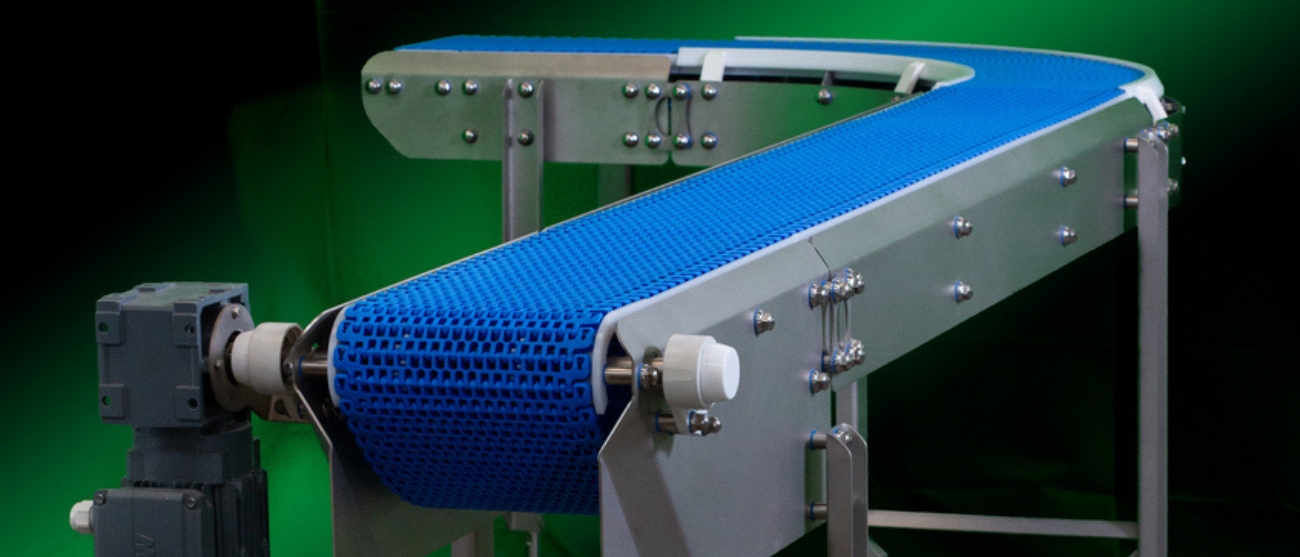
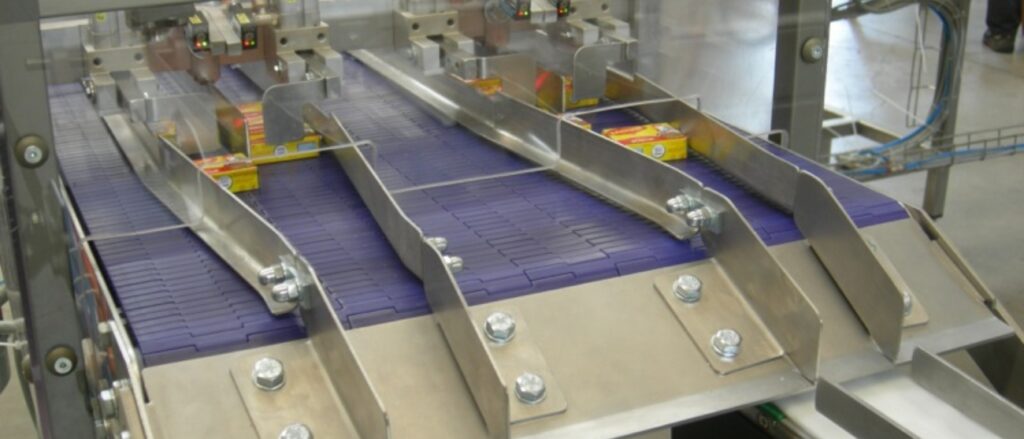
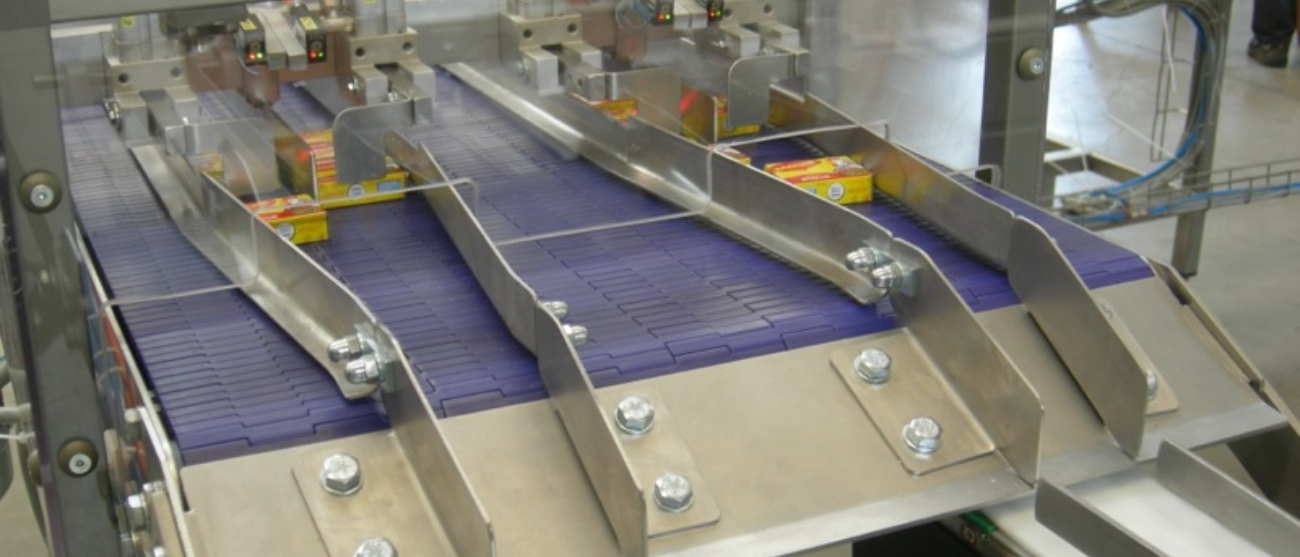
That’s why MH Material Handling developed Saniflex: a conveyor system designed to combine food safety, easy cleaning, and continuous operation.

A solution developed directly in the field, based on real industry needs

Saniflex is not a catalogue product—it’s the result of years of hands-on experience working closely with real food manufacturing environments. In facilities where cleaning must be frequent, thorough, and fast, every component has been designed to simplify sanitation procedures, minimizing time, resource consumption, and contamination risks.

Key features include:

  • open frame with sloped surfaces to prevent water stagnation and support proper drainage;
  • no blind spots, eliminating areas where residues could accumulate;
  • tool-free removable components to ease daily disassembly;
  • polypropylene chain with polyketone pins, highly resistant to common chemical cleaning agents;
  • stainless steel frame in AISI 304 or 316L, with bead-blasted or 2B finish to reduce dirt adhesion and improve cleanability.

Measurable results: less water, fewer stops, higher efficiency

In real-life installations and testing phases, Saniflex has proven to deliver tangible benefits. The system is built to handle frequent cleaning cycles—even several times a day—without hindering productivity.

Key advantages:

  • up to 50% reduction in water and detergent consumption, thanks to faster and simpler cleaning;
  • less downtime, due to quick disassembly and washing;
  • compatible with Clean-In-Place (CIP) systems and monolithic belts like Thermodrive, meeting the requirements of modern production lines.

Saniflex can be seamlessly integrated into both new installations and existing lines. Its modular design allows for high layout customization, addressing space, process, and configuration constraints. Each project is supported by MH’s technical team to ensure optimal integration and performance.

The MH approach: no off-the-shelf solutions, only tailor-made systems

At MH Material Handling, every solution starts from a real need. Saniflex is the perfect example: a system developed for those who don’t want to choose between hygiene and productivity—but demand both. With Saniflex, hygienic design is more than a feature—it’s a real added value.

Want to know if your line meets the highest hygienic standards?

Book a free consultation with MH Scan Solution: together we’ll assess your plant, identify critical points, and propose the best solutions to turn your line into a hygienic, efficient, and compliant system.

If you work in the dairy sector, you understand how challenging it is to manage conveyor solutions across the entire supply chain. With almost 500 types of cheese produced in Italy, over 50 of which have EU Protected Designation of Origin status, transportation and packaging requirements are numerous and demand tailored solutions.

Dispositivi di movimentazione nel settore caseario

In this video, we focus on a crucial aspect: the importance of technology in dairy product handling. We will cover the main challenges and the most effective solutions to ensure an efficient and safe process.

If you want more information about our products or to discover how to optimize your packaging process, do not hesitate to contact us and request our MH Scan Solution—an in-depth diagnosis to analyze and improve your packaging line.

The automation of packaging lines represents a strategic step for companies aiming to improve efficiency, reliability, and productivity. However, to ensure the success of an automation project, it is essential to find the right balance between production goals, financial resources, and structural constraints.

M.H. Material Handling, with nearly forty years of experience in the industry, has faced and resolved numerous challenges related to the integration of automated solutions, adapting them to the specific needs of its clients. In the following lines, we will analyze three key variables that determine the success of automation in packaging lines.

Industrial Automation: The Three Strategic Levers for Efficient Innovation

Production Goals

Defining production goals with precision, such as the number of products per minute or the ability to handle micro-stops, is the first step in developing an efficient line.

Each sector has specific requirements: for example, in the confectionery industry, seasonal lines such as those for chocolate need to be optimized to work at full capacity during winter months and reduce production capacity in summer. Planning based on demand allows for optimized investments and ensures maximum return from production facilities.

Financial Resources

Investing in automation does not necessarily mean building a complete system from the outset. A scalable approach allows for costs to be distributed over time, starting with an essential configuration and progressively expanding the line’s capabilities.

This strategy reduces risks, allows for adjustments based on market trends, and facilitates the adoption of new technologies without placing excessive strain on the company’s budget.

Operational Space

Optimizing available space is one of the most significant challenges in packaging line automation. Production plants, especially in Europe, face structural constraints that make intelligent use of space essential.

Innovative solutions such as spirals, elevators, and overhead conveyors allow for vertical development, reducing floor space usage and improving workflow organization.

Space and Productivity: Turning Every Square Meter into Operational Efficiency

Effectively managing production space is not just a matter of layout but a strategic factor that directly impacts productivity and reduces operating costs.

Overhead conveyors, for example, enable smooth connections between packaging and palletizing areas without compromising ground-level accessibility. However, when dealing with unpackaged products, it is essential to keep processing at the same level and within the same environment to maintain hygiene standards and facilitate product handling.

After primary packaging, multi-level solutions such as elevators and spiral buffers can fully optimize product distribution and improve line efficiency.

How to Integrate New Technologies into Existing Lines?

Integrating new technologies into existing packaging lines is a complex challenge that requires careful planning.

Each new addition must be designed to ensure a continuous production flow and avoid bottlenecks. An often-overlooked aspect is the connection between production lines and the warehouse: poor management can cause interruptions and compromise productivity.

Additionally, adding machinery or conveyor belts must be carefully studied to avoid obstructing operator movement and to facilitate maintenance operations.

For companies that cannot afford long production downtimes, the most effective strategy is to implement automation in phases, minimizing downtime and ensuring a smooth transition.

Automation and Growth: Looking Toward the Future

Investing in automated solutions does not only mean increasing productivity but also improving safety, reducing waste, and ensuring greater operational flexibility.

A well-designed system allows companies to quickly adapt to market changes, maintaining a competitive advantage.

To successfully transition to automation, it is essential to rely on industry-experienced partners like M.H. Material Handling, which offers customized solutions to optimize every phase of the production process.

Thanks to MH Solution Scan—our advanced analysis service—we can identify the weaknesses in your packaging line and propose targeted solutions to increase efficiency and productivity.

Discover how MH Solution Scan can transform your production line and make your company more competitive. Contact us for a personalized consultation.

The industrial production of snacks represents a constant challenge for food companies. Between the growing demand for packaged products and the need to maintain high quality and safety standards, designing efficient production lines becomes a fundamental strategic element.

One of the most effective solutions for optimizing production flow and reducing waste is represented by storage systems, which play a crucial role in managing micro-stops and ensuring operational continuity.

The Production Cycle of Snacks: From Line to Packaging

The production process of snacks is divided into multiple phases, each contributing to the creation of a final product ready for the market. It starts with primary packaging, where snacks are individually wrapped in flowpack, then moves to secondary packaging (cardboard trays) and overwrapping (multiple flowpack). Finally, the products are packed in corrugated cardboard boxes for shipping.

This articulated chain requires perfect coordination between different machines and careful management of operational pauses. Inadequate control of micro-stops can generate significant production inefficiencies. Without a storage system, excess products risk creating congestion along the line, forcing upstream machines to interrupt production.

This scenario is particularly critical for baked products, where production continuity is not only essential for maintaining the quality of the final result but also for ensuring safety. Products in transit through the oven must proceed without interruption: a belt stoppage inside the oven would not only cause burning and consequent loss of the product being processed but could create an even more serious risk. In large industrial ovens, where significant volumes of product are in transit, a blockage could lead to overheating and, in extreme conditions, even fire development, putting at risk not only production but also the safety of the entire facility.

Storage Systems: The Optimal Solution

Companies have two main strategies available to manage micro-stops: investing in standby machines or integrating storage systems.

Although the first option might seem more intuitive, it involves high costs both in terms of initial investment and maintenance. Storage systems, instead, represent a more versatile and economical solution.

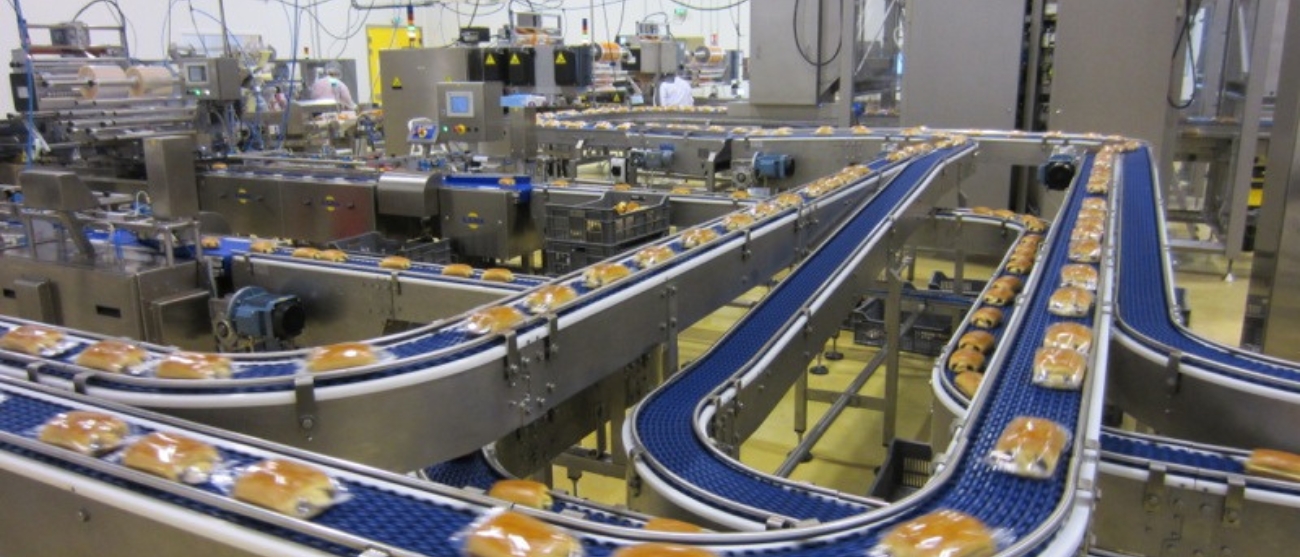
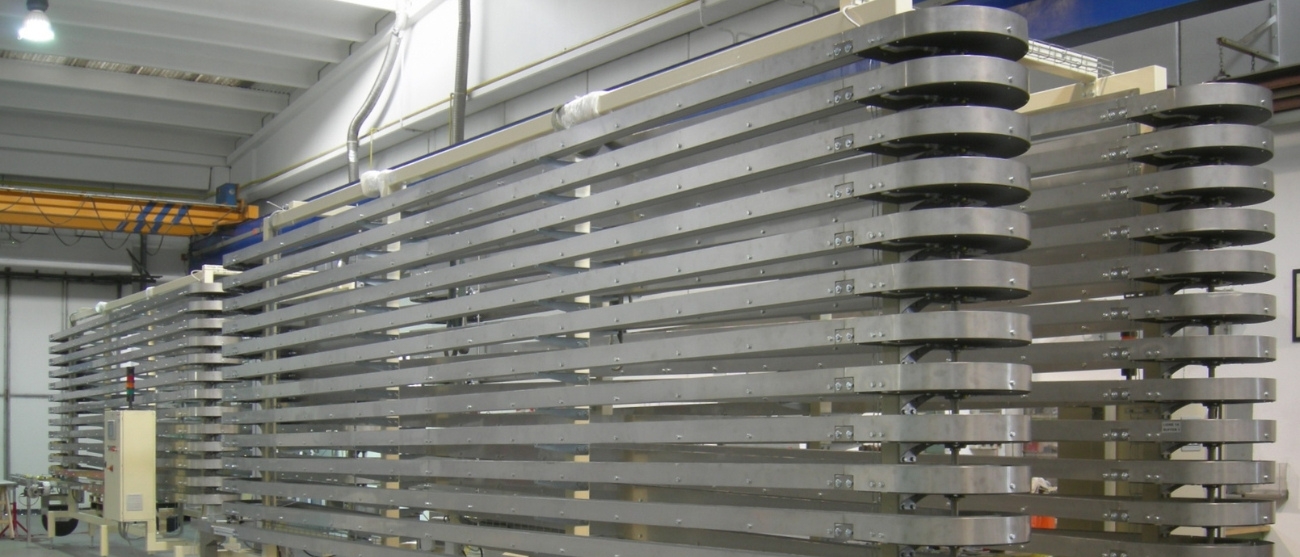
A storage system consists of a conveyor belt with input and output devices, designed to manage excess products in a fluid and organized way. The versatility of these systems allows them to adapt to the specific needs of the production line, optimizing flow without interruptions. Moreover, many storage systems utilize vertical space thanks to spiral designs, reducing floor space and improving plant organization.

Heliflex: An Advanced Solution for Complex Lines

Among storage systems, Heliflex stands out as a solution specifically designed for complex packaging lines like those for snacks. Heliflex uses a unique chain, wound in a spiral around synchronized drums. This design allows for continuous or discontinuous product accumulation, with a capacity that ideally varies between 200 and 500 meters, ensuring optimal use of available space.

One of Heliflex’s main advantages is zero-pressure management, which ensures the integrity of products and packaging. This feature is fundamental for snacks, where damaged packaging could compromise freshness and aesthetic appearance. Furthermore, the system allows products to be returned to the line at any time without having to empty the entire buffer, offering unparalleled operational flexibility.

In an articulated production line like that of snacks, Heliflex is typically positioned after the tray packer, to manage micro-stops of downstream machines, such as overwrapping, case packing, and palletizing.

In more advanced lines, it’s possible to integrate additional storage systems to improve production efficiency. An example is the multi-tier buffer, positioned between the process line and flowpack machines for primary packaging. This system is designed to manage the flow of not-yet-packaged products, handling them in their “naked” form and ensuring fluid and organized management.

Tailored Solutions for More Efficient Production Lines: The Importance of Strategic Choice

Each production line has specific needs, determined by factors such as product type, line speed, and downstream machine capacity. For this reason, the choice of storage system must be carefully planned, considering not only current needs but also potential future developments.

Heliflex represents an example of how technological innovation can respond to these needs, offering a versatile and scalable solution. However, its integration requires careful planning and thorough evaluation of the production layout. For example, using spiral buffers not only optimizes space but also improves overall line efficiency, reducing downtime and minimizing waste.

With MH Material Handling, you can count on tailored solutions to optimize every aspect of your production line. Thanks to our exclusive service, the MH Solution Scan, we can thoroughly analyze your packaging lines, identifying critical areas and proposing the best alternatives to increase productivity.

Don’t let inefficiencies compromise your competitiveness: contact us today and discover how we can help you transform your production into a cutting-edge system, ready for future challenges.

If you are looking for a multipurpose buffer system that can be used in different situations, Heliflex is definitely the right solution for you.

Today I decided to focus on its most classical use, i.e. as a ‘simple’ buffering system, from how Heliflex works to the products for which it is most commonly used.

Thanks to both its cylinders rotating in sync, Heliflex is a very cost-effective system: in fact, it enables the buffer of a higher number of items within a smaller space, thanks to its single motor.

If you would like more information on this multipurpose buffer system and would like to find out if it is right for you, do not hesitate to contact us and ask for our MH Scan Solution, an in-depth diagnosis to analyse and optimise your packaging line.

In the world of chocolate production, efficiency and process quality are essential to meet the expectations of an increasingly demanding market. This need has become even more pressing due to the significant rise in cocoa prices in recent years, pushing companies to optimize every stage of production to remain competitive and profitable.

Among the systems that ensure smooth operations, counterplate transport lines play a crucial role. These systems, designed to support product handling across various production phases, are a prime example of how industrial engineering can enhance performance and reliability in manufacturing processes.

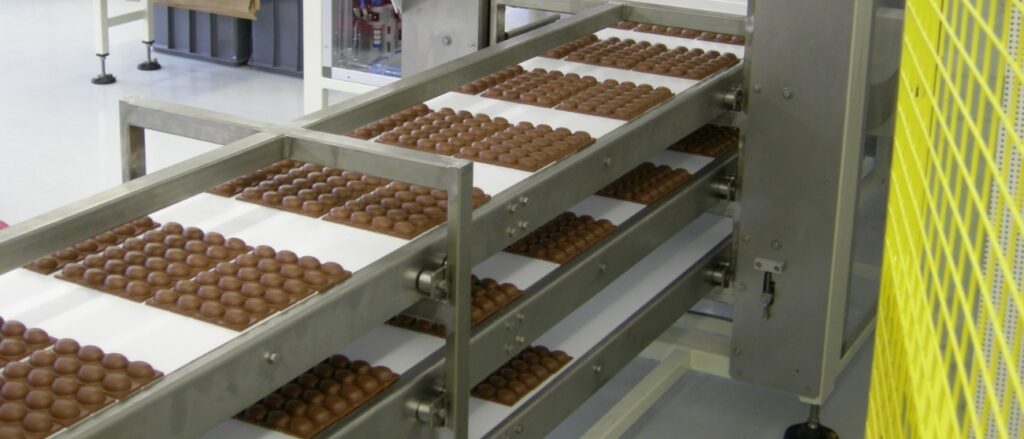
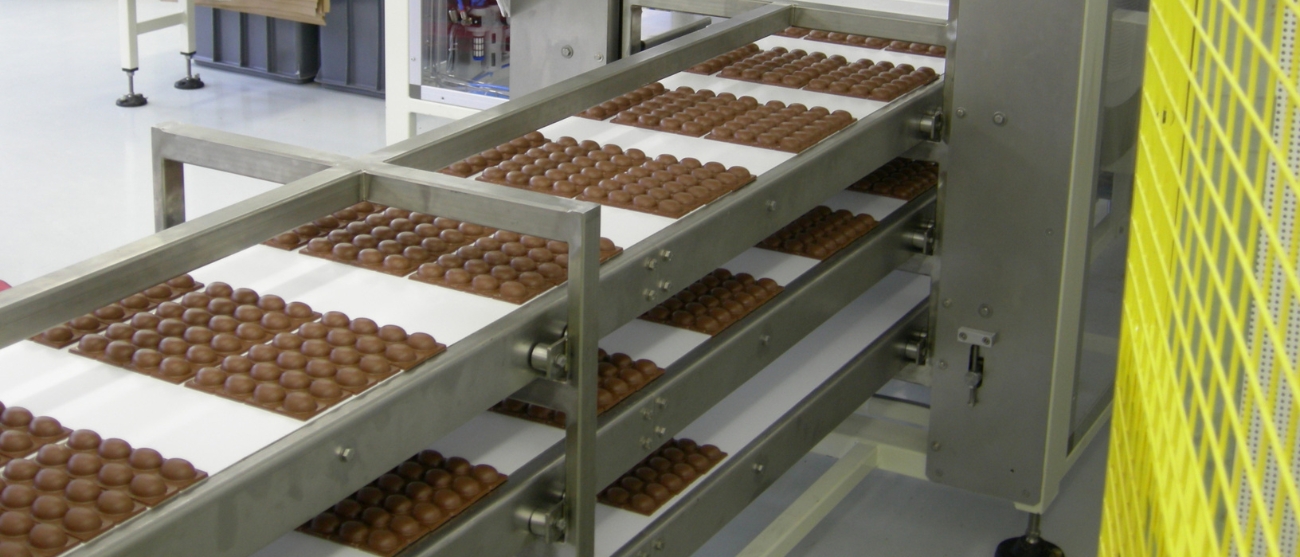
This method is particularly suitable for “hollow products” such as chocolate eggs, bunnies, and other molded figures, as well as pralines—especially irregularly shaped or spherical ones. Given their shape, these products can roll erratically on traditional conveyor belts, making counterplates the ideal solution to ensure proper positioning and stability throughout all production phases.

From Molding to Packaging: How Chocolate Delights Are Made

The chocolate production process is divided into several interconnected stages, all optimized by counterplate transport lines.

1. Molding and Stabilization

The process begins with molding, where raw material is poured into molds to achieve the desired shape. Once solidified, the product is transferred onto counter-molds—mirror structures that ensure product stability and integrity. These counter-molds, known as counterplates, are essential for securing and organizing products during subsequent processing phases, contributing to a smooth and efficient production flow.

2. Feeding the Packaging Machines

At this stage, the counterplates, with products securely nestled in their cavities, are transported to the packaging machines. Here, automated systems like Cartesian or anthropomorphic robots pick up the chocolate pieces for primary packaging. This phase does more than protect the product: the packaging is also designed to enhance the chocolate’s visual appeal, making it ready for distribution and sale. Counterplate transport lines play a vital role in managing flows toward multiple packaging machines, preventing bottlenecks with accumulation systems that reduce waste and ensure operational continuity even during machine downtime.

3. Recycling Counterplates

Once the product transfer is complete, the empty counterplates are reintegrated into the production cycle. Tipping and shaking systems ensure no residues remain, while the return process often takes place on separate levels to optimize space. Before demolding, buffer systems regulate product flow to maximize efficiency.

Advanced Solutions to Optimize Production

In addition to ensuring product transport, counterplate lines incorporate innovative devices that improve efficiency and versatility.

  • Elevators: Lift the plates for precise positioning on the transport line.
  • Buffers: Accumulate products to prevent interruptions in the production flow.
  • Tippers: Flip plates for correct positioning at each phase.
  • Bypass Systems: Temporarily redirect flow to maintain production continuity.
  • Alignment Devices: Ensure every chocolate piece is perfectly oriented for packaging.

Why Are Counterplate Transport Lines Essential?

These systems not only guarantee the final product’s quality but also optimize resource and space management. They help maintain high hygiene standards, minimize waste, and increase overall productivity. Their ability to adapt to various production needs makes them indispensable for chocolate manufacturers.

Optimize Your Production Line: Discover MH Solution Scan

In such a complex production environment, planning and optimizing transport lines are key to maintaining a competitive edge. The MH Solution Scan is the ideal solution: an advanced diagnostic service designed to analyze every aspect of your packaging line in detail. This tool identifies critical areas, proposes customized solutions, and ensures that every production phase is optimized.

Don’t let inefficiencies compromise your production: contact MH Material Handling to learn how we can help you transform your line into a cutting-edge system, ready for the challenges of the future.

In modern packaging lines, palletizer feeding plays a crucial role in ensuring a continuous and smooth production flow. Although the use of low-pressure accumulation conveyors is now well-established, in recent years we have witnessed a real technological evolution that has redefined operational methods in this field.

From Limited Slip Rollers to Modular Chains

In the past, palletizer feeding was mainly managed through friction rollers. Today, the trend has shifted to the use of modular chains with embedded rollers, which, although requiring a higher initial investment, offer numerous advantages.

Modular chains ensure:

  • Simplified maintenance, maintenance operations faster and more efficient. Time reduced by up to 50%.
  • Better product handling, thanks to the denser pitch of the modular chain’s idle rollers compared to friction rollers, allowing for the handling of smaller products and better preservation of their integrity by reducing specific pressure.
  • Long-term efficiency, as the higher initial investment is widely compensated by operational benefits that translate into reduced maintenance costs over the years.

Aerial Lines: An Increasingly Popular Strategy

Another growing trend in feeding lines is the installation of conveyors on high ground, hanging from the ceiling or supported by columns, a solution previously reserved for large productions but now spreading even to small plants.

This is because the advantages of overhead lines include:

  • Space optimization, as they free up the work floor, allowing for better management of areas in the plant.
  • Better ergonomics, as they facilitate operator movement and increase safety within the plant.
  • Integration with automation, as they allow the use of automated transport systems, further optimizing productivity.

This is another interesting point, as the increasing use of AGVs (Automated Guided Vehicles) and AMRs (Autonomous Mobile Robots) for material handling within plants makes it even more advantageous to have free and well-organized spaces.

Feeding Lines with Automatic Format Change: The New Frontier

In recent years, there has also been an increase in demand for feeding lines with automatic format change, a technology that allows switching from one format to another from the control panel. This is pretty much mandatory for aerial lines, where manual changeovers would be extremely time consuming. This solution has become particularly useful for companies that need to manage an increasingly varied range of products or operate in markets where demand changes rapidly.

Automatic format change allows for:

  • Production flexibility: Minimizes downtime during format changes, ensuring continuous production.
  • Reduction of operational costs: Minimizes manual interventions and optimizes the use of human resources.
  • Increased productivity: The ability to quickly change formats allows for maintaining high production volumes, ensuring superior efficiency.

Advanced Solutions from MH Material Handling to Optimize Your Production

At MH Material Handling, we are dedicated to providing tailored solutions to improve the performance of production lines, integrating innovations such as modular chains and overhead lines. Investing in advanced technologies for palletizer feeding is a strategic choice to improve efficiency, reduce maintenance costs, and increase long-term productivity, while maintaining the flexibility needed to respond to the challenges of a constantly changing market.

MH Material Handling is by your side to guide you towards more efficient and versatile production. Contact us to find out how we can optimize your feeding line and ensure its future competitiveness.

Today, sustainability is at the core of many companies’ strategies, especially in the food sector. Consumers are increasingly aware of the environmental impact of the products they buy, prompting manufacturers to look for greener and more innovative solutions.

However, when it comes to food packaging, the issue becomes more complex. It is not enough to choose new environmentally friendly materials; it is crucial to find the right balance between sustainability, safety and food preservation.

In recent years, the use of paper as a packaging material has grown significantly, driven by increased environmental awareness among consumers and increasingly stringent regulations that incentivise the adoption of more sustainable solutions. However, the transition is not without its challenges, especially when comparing the properties of paper with those of plastic.

Paper vs plastic: the technical challenges in food packaging

Despite its widespread use, paper is not the universal solution. This is because in secondary packaging, it performs well, but when it comes to directly protecting food, challenges arise.

First of all, paper does not provide the same level of protection from external agents as plastic does, particularly for foods with a high moisture content or animal fats, forcing many companies to combine paper with plastics or aluminium. This compromise makes the packaging less recyclable and often defeats the sustainability goal that is being sought.

However, there are also paper films with a barrier layer that are recyclable as a monomaterial. These, however, have severe limitations in terms of protection, being suitable only for products with specific characteristics and a very low level of residual moisture.

The problem then is clear: it is not just about sustainability, but about ensuring food safety. Packaging must ensure that the product reaches the end consumer intact and safe. Pushing ‘green’ solutions such as paper in packaging might seem like the right choice, but if this involves adding plastic barriers or aluminium, it risks making the packaging less recyclable and increasing costs without achieving real environmental benefits.

The evolution of packaging machines for sustainable production

With the increasing use of environmentally friendly alternatives such as paper or single-material plastics, but with thicknesses that are becoming increasingly thinner, packaging machines must also evolve to adapt to these new materials, which have very different physical characteristics to plastic.

Traditional packaging lines, designed to work mainly with plastics, need to be rethought to handle sustainable materials efficiently, without compromising packaging speed or accuracy. This requires careful adjustment of the machines to ensure an efficient production process.

At MH Material Handling, we offer targeted solutions to help companies optimise their production lines, integrating processes with sustainable material innovations, without sacrificing efficiency and precision. However, the introduction of environmentally friendly materials also requires specific attention to the handling of products along the packaging line.

For example, in order to guarantee an optimal production flow with reduced packaging, it is essential to limit contact with the side guides as much as possible. In some cases, the use of high-friction chains or belts can be the ideal solution to keep products stable on the conveyors. When direct handling is required, it is preferable to activate and move products from below, thus reducing the risk of jamming and maintaining smooth operation.

But at MH Material Handling we are also firm on one central point: although sustainability is a priority objective, food safety must remain first. There is no point demonising plastic or adopting ‘greenwashing’ solutions that push paper into packaging if this involves the use of plastic barriers or layers of aluminium that reduce the recyclability of packaging. True sustainability implies finding solutions that balance environmental friendliness and safety while ensuring product integrity and production efficiency.

As a concrete example, Saniflex is one of our solutions – developed for the transport of naked products – that meets the most stringent food safety guidelines. Saniflex arose from the need to respond to special situations requiring the reduction of bacterial load in production and packaging lines.

Saniflex is characterised by the following features:

  • Fully washable structure, designed to be free of hard-to-reach areas during cleaning.
  • Easy disassembly without tools, allowing the operator to quickly remove components requiring more thorough sanitisation.
  • Use of materials that are resistant to frequent washing with aggressive chemicals, which is essential to ensure the reduction of the bacterial load.
  • Stainless steel  structure to ensure maximum resistance to intensive washing.
  • Materials certified for direct food contact and cavity-free components to facilitate the sanitisation process.
  •  Covered threads and spacers with gaskets, designed to simplify washing.

Saniflex is designed to make sanitising quick and easy, minimising downtime by allowing components to be disassembled and reassembled without tools. This solution is particularly suitable for keeping the organoleptic characteristics of food intact, effectively meeting today’s food safety and hygiene requirements.

Saniflex is just one of the many solutions that MH Material Handling provides to meet the challenges of the food packaging industry. We also offer elevation systems to optimise space, sorting systems to handle the most complex lines, and accumulation systems designed to maximise production efficiency.

In order to support companies towards a truly sustainable transition, MH Material Handling offers the ‘MH Solution Scan’: a comprehensive analysis of packaging lines, designed to identify areas for improvement and suggest tailor-made solutions. With this tool, companies can increase sustainability without compromising safety or operational efficiency, making their production lines ready to face the challenges of the future.

The introduction of automation in packaging lines represents a challenge but also a great opportunity for food companies, especially in emerging markets.

Yet many lines stop, in terms of automation, at the primary packaging, an indispensable step to get products onto the shelves. However, secondary packaging is an equally strategic step to improve overall efficiency.

Automate to reduce costs? Not so simple

One of the first goals for project managers is automation as a means of reducing the number of operators. But beware: it is important to be aware that automation can impact line flexibility. While manual operations offer inherent flexibility, automating everything can be costly, especially for lines that have to handle a wide variety of formats.

In this context, the goal of automation should be to increase productivity by reducing the variability of formats, while maintaining production flexibility. A winning strategy could be to move products that have less incidence to dedicated or semi-automated lines.

Attention to space: automation requires planning

Space in the factory is another crucial variable. The installation of automated machines requires adequate operating space, not only for the footprint of the machines themselves, but also for maintenance and the continuous flow of materials.

It is therefore essential to carefully plan the layout of the production line, avoiding that new machines obstruct the operational flow or restrict access to working areas.

Warehousing and logistics: connection is key

L’automazione porta con sé un aumento della produzione, che significa una gestione dei materiali più intensa. Collegare efficacemente la linea di produzione al magazzino diventa fondamentale per evitare colli di bottiglia. Per questo motivo, l’uso di pallettizzazione manuale e movimentazione tramite transpallet potrebbe non essere sufficiente. È necessario considerare soluzioni automatizzate per la gestione del magazzino e il trasporto dei prodotti finiti, al fine di garantire un flusso continuo ed efficiente.

Focus on operator safety

The ergonomics of the production line is another aspect that should not be underestimated. When introducing new machines and connecting conveyors, there is a risk of closing vital passages for operators or creating difficulties in the replenishment of packaging materials. Here again, careful planning of the layout is crucial, to ensure that workers can operate safely, as well as guaranteeing an optimal, smooth workflow.

Gradual automation: a strategic choice

It is clear that secondary packaging automation is a strategic investment for food companies. The benefits in terms of efficiency and safety are tangible, but careful planning is essential to ensure that the transition to automation goes smoothly.

Automating a production line in one go can put pressure on the entire plant, with the risk of production being halted for weeks or months. A more prudent strategy is to implement automation in successive steps. This approach allows each step to be tested and validated, gradually training operators and reducing the risks of production downtime.

At M.H. Material Handling, we support our customers at every stage of the automation journey, from design to implementation, ensuring that every investment brings tangible and lasting benefits. Thanks to our vast experience in the sector, we are able to provide customised solutions that meet the specific needs of each company.

Aware of the many challenges that food companies face, we offer an exclusive tool to optimise the entire process: the ‘MH Solution Scan’. This is an advanced and comprehensive diagnosis, designed to thoroughly analyse your packaging line. This advanced technology allows you to precisely identify areas for improvement, suggesting the most effective solutions to increase efficiency, optimise production flow and reduce operating costs.

With MH Solution Scan, you can quickly identify critical points and take the right countermeasures to transform your production. Our team will accompany you all the way, offering you the experience and technology you need to enhance your operations and achieve concrete results. Find out how MH Solution Scan can make a difference in your production line and lead your company towards a future of greater efficiency and competitiveness.

Insights, ideas and news
about product handling

A high-quality packaging line can deliver reliable performance for decades, especially when supported by careful engineering and proper maintenance.

The service life of a system represents significant value, but being fully operational does not always mean it can meet today’s production, technological and regulatory requirements.

New packaging materials, sustainability goals, and increasingly demanding industry standards require systems capable of evolving – a particularly important consideration in the food industry, where hygiene, ease of cleaning, and safety are fundamental requirements.

Do you want to learn how to adapt your system to new regulations and changing production requirments?

Contact us for a technical consultation.

Converging multiple product lanes into a smaller number of lanes may seem like a simple operation. In reality, the way products are collected, timed and delivered to the downstream machine can have a significant impact on the consistency of the entire process.

This is why designing a lane merger is not simply a matter of considering line speed. First of all, it is necessary to understand how the product behaves: its shape, stability, fragility, ability to run in contact with other products, and the pitch required by the downstream machine are all factors that help define the right solution.

Based on these parameters, M.H. Material Handling designs the merging configuration best suited to the characteristics of the line and the product.

The first criterion is the product: can it withstand accumulation?

Even before speed is considered, the assessment starts with the product and its ability to withstand accumulation.

A product that can tolerate accumulation can withstand the pressure generated by products touching and pushing against one another. Boxes, trays and products stacked in tightly packed formats fall into this category.

A fragile product, or one prone to overlapping, cannot withstand this type of stress, and a pressure-based system could compromise its integrity.

This is why resistance to accumulation is the first factor to be assessed, as it determines whether a pneumatic or dynamic lane merger is required even before line throughput is considered.

There is, however, one useful exception to bear in mind.

Even with a product that can withstand accumulation, the presence of many formats with significantly different widths often makes a dynamic solution preferable. This avoids format changeovers using adjustable or automatically controlled guides and, because the products do not come into contact with one another, eliminates the risk of misalignment.

Pneumatic, DU Series or HP Series: the right technology for each product

A pneumatic lane merger is the simplest and most cost-effective solution, but it is suitable only for products that can tolerate accumulation.

It operates using gates on the infeed lanes, which release the product rows in sequence, and requires two conditions: the products must be able to withstand pressure during accumulation, and the downstream machine must be capable of receiving products in a continuous train without being adversely affected.

The second requirement has a specific technical reason. At the outlet, the products are close together or touching. When this train reaches the downstream machine, the instantaneous speed seen by the machine is therefore twice the average speed. Either the downstream equipment must be able to handle this, or the flow must be normalised using a deceleration conveyor followed by an acceleration conveyor, at the cost of a larger footprint, two additional motors and more complex control logic.

The pneumatic solution is also well suited to a particular application: where the carton itself is the primary package, as is common in the pasta industry, in the section between secondary packaging and the case packer, where the product can be accumulated.

When, on the other hand, the product is delicate or must be handled without contact, dynamic lane mergers are used. M.H. offers two series.

The DU Series merges products by reducing the number of lanes through anti-overlap timing belts operating at controlled differential speeds, one for each infeed lane. Products are handled individually and without contact, making the system suitable for fragile products or products prone to overlapping, at speeds of up to approximately 240 pieces per minute.

The HP Series is the evolution of the DU Series, developed specifically for high-speed flow-wrapping lines and for connections between primary and secondary packaging. In this case, pressure is completely eliminated because the products must never come into contact. Each item is individually timed by means of a multi-belt system with independent brushless drives for every infeed lane, combined with blower-generated vacuum for higher acceleration rates, reaching up to 600 pieces per minute at the outlet. In flow-wrapping applications, precise product timing is essentially mandatory, as it is the only way to prevent products from overlapping.

Outlet pitch: a detail that should not be underestimated

As speed increases, it becomes essential to achieve the most consistent possible product pitch at the outlet of the lane merger, because this determines how the downstream machine receives each item.

A product flow delivered in trains can push the downstream machine beyond its production limits because of the instantaneous speed peaks described above. Individual product timing, on the other hand, controls the distance between packs and transfers them without contact, reducing the risk of jams and overlaps.

The choice always starts with the product

In every case, the starting point is always the product. The first step is to determine whether it can withstand accumulation, then assess its fragility and shape, the required production rate and the number of lanes to be merged, and finally the type of downstream machine, particularly whether it is a flow wrapper positioned between primary and secondary packaging.

The right technology emerges from these answers: a pneumatic lane merger for products that can withstand pressure, the DU Series for products requiring contact-free handling, and the HP Series for high-speed flow-wrapping applications.

At M.H. Material Handling, we manufacture material-handling systems and efficiency solutions for packaging lines in the food industry and related sectors. Over more than forty years of field experience, from food & beverage to pharmaceuticals and packaging, we have developed the expertise required to identify where lane merging can make a real difference and where it is unnecessary. On this basis, we design customised pneumatic and dynamic lane mergers from the DU and HP Series, starting with an analysis of the production line.

If you are planning a new line or a revamping project and lane merging is still an open issue, we can assess it together to identify the most suitable configuration.

Is your packaging line inefficient? Just add a buffer and the problem is solved.

Or at least, that’s what many people think.

Adding a buffer to an existing line can turn into an expensive and unnecessary investment. Before proceeding with the installation, carefully assess all the preliminary factors: an in-depth analysis can help you avoid ending up with the same problems you started with.

To identify the most suitable solution for your packaging line, contact us: we’ll analyse your specific case and help you define the most effective solution.

What happens when the connection between the machines in a packaging line is not designed correctly?

The risk is that slowdowns, accumulations, micro-stoppages and disruptions in the flow may occur, affecting the efficiency of the line and, over time, the overall performance of the plant.

This is the idea behind the new video series from ConveyorU, the M.H. Material Handling Academy dedicated to intelligent product handling in packaging lines.

Guiding you through this journey are Convy, the Academy’s mascot, who asks the questions of those who work in production plants every day, and Luca Fontana, CEO of M.H. Material Handling, who answers based on forty years of experience in line design.

In this first episode, they address an apparently simple question: why are conveyors so important?

As the video shows, the value of a conveyor depends on how it is integrated into the line, the required speed, the operating conditions and the specific production requirements.

The required characteristics also vary significantly depending on the industry: a line dedicated to food or pharmaceutical packaging has different priorities compared to an application in logistics, mechanical engineering or the automotive industry.

This is just one of the topics covered by ConveyorU, a journey dedicated to the different aspects of product handling and packaging line efficiency.

Do you want to improve the efficiency of your line?

Every line has different conditions, products and critical issues. To identify areas for improvement, it is therefore necessary to analyse the process as a whole, looking at how the machines interact and how the product is handled.

The M.H. Material Handling team can help you assess your line, identify any critical points and develop a solution based on the actual needs of your plant.

Contact us to discuss your application and discover how to make your product handling more efficient, continuous and easier to manage.

It happens for different reasons. Sometimes it is a decision made by the purchasing department aimed at reducing costs. Sometimes the end customer requests less plastic. Sometimes it is compliance with new European packaging regulations, such as the PPWR Regulation. Sometimes it is all of these things combined.

Whatever the reason, when the primary film gets thinner, the package becomes lighter and more deformable.

On the conveyor, however, this means less stability.

On the conveyor, just a few microns change everything

A 28-micron film creates a very different pack from a 40-micron one. Lighter and more flexible, it is more affected by any type of contact – whether with product guides or with other packs in accumulation zones. The risk of deformation or overlapping inevitably increases.

Downstream, this results in micro-stops and scrap, and often in complaints from customers receiving damaged products.

The packaging machine continues to run as usual, but the entire section between production and packaging is no longer suitable for the new format. As a result, speeds, chain type, side guides, and contact surfaces all need to be reconsidered, because the entire conveying section must be recalibrated according to the new mechanical properties of the pack.

The buffer that worked yesterday may no longer be suitable today

An accumulation system is designed based on the real parameters of the format, such as weight, rigidity and pack dimensions. When these parameters change – for example, when switching to lighter or more flexible packaging – the behaviour of the product inside the buffer changes accordingly. In a pressure-based system, a less rigid pack therefore risks deformation or damage during accumulation if everything is not correctly set.

The MH Material Handling BAT Buffer operates without pressure on the product and is designed to be flexible and configurable across multiple formats and layouts. This makes it suitable even for lightweight and delicate packs.

However, flexibility does not mean that a single setup works for everything: if the format changes significantly and the buffer is not readjusted, the risk of jams and damage remains.

A useful rule of thumb during the design phase is that a buffer should hold between 2 and 5 minutes of production: the time needed to absorb the typical micro-stops of the line without losing productivity. With lighter formats, however, it is worth recalculating both the effective accumulation capacity and the discharge speed, considering that the downstream machine should be able to run at least 10–20% faster than average to recover the accumulated product.

Downstream of the packaging machine is where the real game is played

When package weight and rigidity change, the requirements of the downstream section of the primary packaging also change. All downstream mechanics – aligners, phases and lane combiners – are suddenly handling a product that is no longer matches the original design assumptions.

The packaging machine keeps running, but the downstream area – the one nobody actively monitors – is where efficiency is lost.

That is why every format change requires a check of the feeding and conveying systems, and it must be done before problems arise.

How to adapt the line without stopping production

The process starts with mapping the characteristics of the new package: weight, dimensions, rigidity and coefficient of friction.

The new format is then tested across every section of the line, not only on the packaging machine, because each section reacts differently and must be checked individually.

The most important step is to involve the conveyor supplier already during the design phase, not once the problem has already become evident.

Working in stages – validating one section at a time before moving on to the next – allows production to remain active while reducing risks.

The format changes. The line cannot stay the same

When a company decides to reduce packaging weight or thickness – whether to cut costs or to meet sustainability requirements – the decision usually starts in the purchasing department. A thinner film is selected, the price is negotiated, and the specification is updated in the system. And then it stops here.

The problem is that no one checks the impact of that change on the packaging line. The process engineer is not involved, at least not immediately. They are called in weeks later, when machine downtime starts to increase, scrap rises, and OEE drops without an obvious cause.

The machine is the same. The product is the same. However, the packaging has changed, and that change affects the entire line: from packaging to accumulation, from conveying to palletizing.

For over 40 years, MH Material Handling has been designing conveying and accumulation systems. We work on layout analysis, buffer configuration, feeding system adaptation, and the integration of new solutions into existing lines, ensuring everything works with today’s format, not yesterday’s.

If you are considering a format change, or if you are already facing issues after a reduction in material thickness, let’s talk before inefficiencies become the norm. A preventive technical discussion costs far less than a stopped line.

It’s 6:45 a.m. The line is down for end-of-shift cleaning. The operator directs a high-pressure water jet onto the conveyor, moving the lance from left to right, then shuts off the valve.

On the surface: clean.

In reality: the frame beneath the belt has three enclosed corners where water never reaches. Organic residue builds up there, day after day.

This is not a cleaning issue. It’s a machine design issue. And the difference between a line that passes a hygiene audit and one that barely gets through – every single time – comes down to this.

Washdown: effective on paper, limited in practice

Washdown – high-pressure cleaning with water and detergents – is the most common response to contamination risks in food processing lines.

It’s relatively inexpensive to implement and provides an immediate sense of control.

The problem is that it only works if the machine has been designed to be cleaned. If the frame has enclosed cavities, if chain returns are inaccessible, if joints retain moisture, the water jet doesn’t solve the issue. It just relocates it. The result is increasing consumption of water and chemicals, longer downtime, and a real risk of cross-contamination. Meanwhile, the quality manager signs off on sanitation reports that, in practice, cannot be fully guaranteed.

Hygienic Design eliminates the problem at the source

Hygienic Design, when applied to machinery, is a design approach that starts with a specific question: how can this machine be thoroughly cleaned, under real operating conditions, with the available personnel, in the shortest possible time?

A conveyor built with this logic features open-frame construction, sloped surfaces for effective drainage, tool-less disassembly, food-grade certified chains, and materials resistant to aggressive cleaning agents.

It’s not “washable” because someone claims it is – it’s washable because there are no areas where residue can accumulate.

From an operational standpoint, the impact is significant: sanitation downtime is reduced, water and chemical usage decreases, and contamination risk is minimized. Hygiene audits become a natural outcome of the design – not a recurring uncertainty.

Not every line carries the same risks – that’s why choosing the right approach matters

In practice, the choice between a Hygienic Design approach and a Washdown system depends on where the conveyor is positioned within the line and the type of product it handles.

For unpackaged products – fresh food, meat, dairy, bakery – the contamination risk is extremely high. Here, Hygienic Design is the minimum requirement.

Monolithic belts with no internal fabric, such as the SaniBelt line we design at MH, are specifically developed for this purpose. They have no exposed textile surfaces that can retain residue and can be cleaned in just a few minutes.

When handling packaged products, still within a white area, requirements change. A washdown design can be sufficient, provided stainless steel construction is maintained and flat surfaces and enclosed cavities are avoided. In this case, tool-less belt removal for cleaning is no longer essential. Moving into grey areas, hygiene requirements can be relaxed further, with greater emphasis on robustness and throughput. Depending on the environment, you may still opt for stainless steel frames – for example, where floors are regularly washed with water – or choose anodized aluminum structures where this is not required.

3 practical steps to quickly identify critical points in your line

Before deciding whether to upgrade a single conveyor or redesign an entire section, you need a simple method to identify where the real issues lie.

Here are three key aspects to assess your current situation:

The first step is to map the line by hygiene risk level

Open product, packaged product, and transition zones. For each area, define the conveyor type and the current cleaning regime.

The second step is to inspect critical design points

Enclosed frame corners, cavities beneath chain returns, joints between modules, and moisture-prone areas. If you can’t reach a spot with a cloth, water won’t clean it effectively either.

The third step is to measure actual sanitation time

If it exceeds 20 minutes per conveyor in high-risk areas, you have a design problem. And remember: no stricter cleaning procedure can compensate for a design flaw.

A layout is designed once -but it’s lived with every day

The issue is that most companies address hygiene only when the problem is already visible: a difficult audit, a product recall, or uncontrolled sanitation costs. At that point, the room for action is limited.

At MH Material Handling, we have been designing conveying systems based on these principles for over forty years. From the Saniflex belt for high-risk areas to the BAT system with USC chain for high-speed lines, every solution starts from a real analysis of the customer’s operating conditions – not from a standard catalog. If your sanitation times are too long, if hygiene audits are always uncertain, or if you are designing a new line, get in touch. We can analyze your processes together and identify the most effective solutions to protect product safety and reduce operating costs.